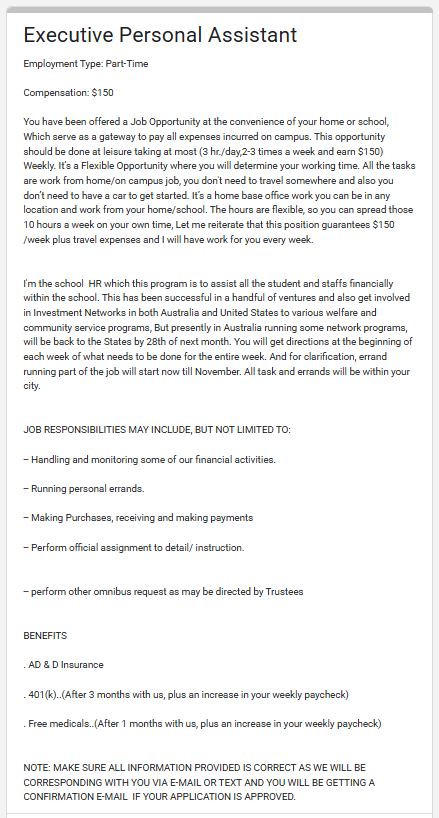
Students and teachers received an email Nov. 14 supposedly from welding teacher Stephen Byrd about a job opportunity. That email was sent by someone who gained access to Byrd’s account. Those who opened or submitted the form had to reset their accounts and change passwords Nov. 17.
“I was very annoyed to say the least,” Byrd said. “I’ve got a lot of stuff going on: I got grades that I need to get put in, I got comp guys that I need to get situated. It’s one more thing to add.”
The email offered $150 weekly for certain tasks. It all could be done from home and offered many benefits: free medicals, 401K and AD&D (Accidental Death and Dismemberment) insurance.
“As a precaution, we have temporarily frozen all student email accounts at the high school to prevent further exposure,” Superintendent Chane Rascoe said in an email across district Nov. 17. “Our technology department is actively investigating the incident, and we have notified all agencies who will help to complete an investigation into this phishing attempt.”
Since all students received the email, many filled out the form without questioning.
“I thought nothing of it when I clicked on the form,” sophomore Faith Stembridge said. “I almost started filling it out until I saw the questions asking for my billing address, and then I immediately closed it.”
Principal Paul Weinheimer said there have been phishing attempts in the past, but it has never reached the students’ emails.
“I was concerned that students or staff information may be compromised,” he said.
Byrd said he first heard about an email sent from his account when a student asked him why there was an email sent to their sister at the middle school about a job opportunity.
“Then reports just started flooding in, and pretty soon I got a call from our principal asking if I sent it,” he said. “Obviously, I had not, so we started taking steps to break that.”
After realising that the email sent wasn’t from Byrd himself, Stembridge said this had taught her to double-check and follow up with teachers about odd emails.
“I was shocked,” Stembridge said. “I saw the email from ‘Mr. Byrd,’ and I knew him; he is a trusted teacher, but to find out that he was used as a pawn in someone’s sick game of chess, I was appalled.”
Weinheimer said students should be cautious when receiving emails with external links. This not only disrupted the learning environment, but it could also have turned into a district-wide issue.
“Our LHS technologist, Beth Oestreich and our LISD technologist, Ron Poage, were instrumental in helping protect our students from these phishing attacks,” Weinheimer said. “They were also instrumental in ensuring the threat was taken down as soon as possible.”
With the increase in technological advancements, both students and staff alike need to be cautious where their information is going.
“Take cyber security seriously,” Byrd said. “Those students who know me, you know if I’m going to give you a job opportunity, it’s going to be face-to-face. If it looks too good to be true, guaranteed it is going to be too good to be true.”